


The Dynasty That Ruled Assam for Nearly 600 Years
Introduction
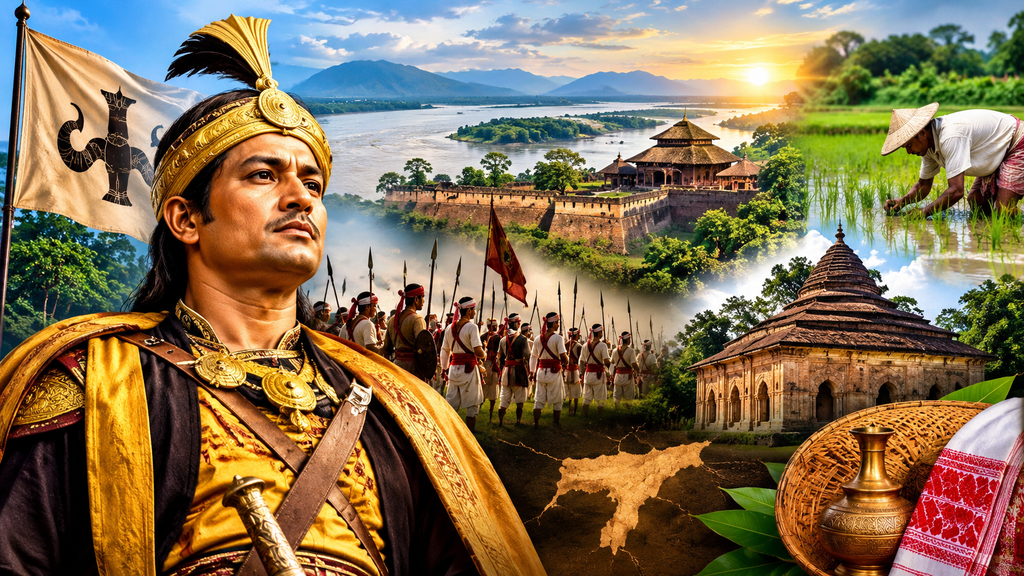
The Ahom Kingdom holds a significant place in the history of Assam. Founded in 1228 CE by Chaolung Sukapha, the Ahoms ruled much of the Brahmaputra Valley for nearly six centuries. Their contributions to administration, agriculture, military strategy, and architecture shaped Assam’s historical and cultural identity.
- Foundation of the Ahom Kingdom
Chaolung Sukapha, a Tai prince, entered the Brahmaputra Valley in 1228 CE and established the foundation of Ahom rule. Through alliances and interactions with local communities, he gradually expanded his influence. Charaideo became an important early political centre of the kingdom.
- Administration and Paik System
The Ahoms developed an organised administrative structure with officials such as the Borphukan, Borgohain, Burhagohain, and Barbaruah.
One of their most notable administrative features was the Paik system, which provided labour and military services to the state. It helped organise public works, maintain administration, and strengthen the kingdom’s military capabilities.
- Ahom-Mughal Conflicts
The Ahom Kingdom faced repeated Mughal attempts to expand into Assam. In 1662, Mughal general Mir Jumla invaded the kingdom, forcing the Ahoms to accept the Treaty of Ghilajharighat in 1663.
However, the Ahoms reorganised their forces and continued resisting Mughal expansion.
- Battle of Saraighat (1671)
The Battle of Saraighat was one of the most significant military events in Assam’s history. Led by the legendary Ahom general Lachit Borphukan, the Ahom forces successfully resisted the Mughal army commanded by Ram Singh I.
The Ahoms effectively used the Brahmaputra River, local geographical knowledge, and naval tactics to defend their territory. Lachit Borphukan remains a symbol of courage, leadership, and patriotism.
- Architecture and Cultural Heritage
The Ahom rulers left behind remarkable historical monuments that reflect their architectural achievements.
- Rang Ghar: A historic amphitheatre in Sivasagar associated with royal entertainment and sporting events.
- Talatal Ghar: A significant Ahom-era architectural structure known for its distinctive design.
- Charaideo Maidams: Royal burial mounds representing the funerary traditions of the Ahom dynasty. They were inscribed on the UNESCO World Heritage List in 2024.
These monuments remain important symbols of Assam’s rich cultural heritage.
- Decline of the Ahom Kingdom
The decline of Ahom rule resulted from internal conflicts, the Moamoria Rebellion, and Burmese invasions. These developments weakened the kingdom and destabilised Assam.
The Treaty of Yandabo, signed in 1826, ended the First Anglo-Burmese War and marked a turning point in Assam’s political history, paving the way for British control.
Conclusion
The Ahom Kingdom was one of the longest-lasting dynasties in Indian history. Its contributions to administration, military strategy, architecture, and cultural development continue to influence Assam’s identity.
From Chaolung Sukapha’s vision to Lachit Borphukan’s leadership at Saraighat, the Ahom legacy remains an essential part of India’s historical heritage.
