
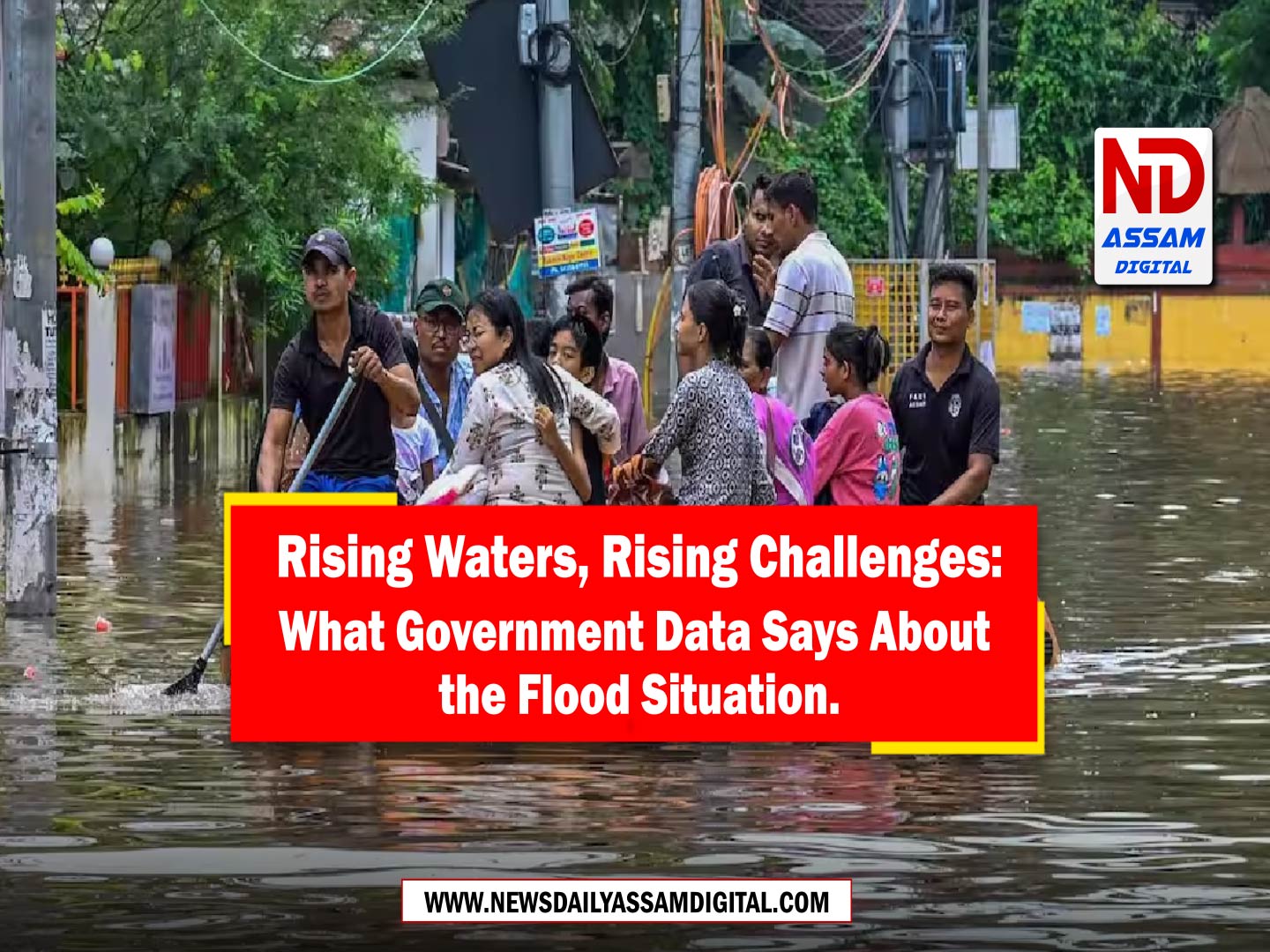

With the arrival of the monsoon, a wave of joy sweeps across India, as if every living being has been given a new lease on life. The rains bring relief from the scorching summer, replenish rivers and reservoirs, and breathe vitality into the country’s agriculture and ecosystems. However, for several Indian states, the monsoon also marks the beginning of a recurring crisis. Along with life-giving rains come devastating floods that disrupt livelihoods, displace communities, and claim lives. One such state is Assam, where annual flooding has become an enduring challenge, affecting millions of people year after year. According to the Assam State Disaster Management Authority (ASDMA), nearly 40 lakh (4 million) people may be affected during severe flood years, with more than 28 of the state’s 35 districts impacted in extreme events. Till now , more than 5.64 lakh people have been affected by floods in Assam so far, and the death toll has reached above 40.
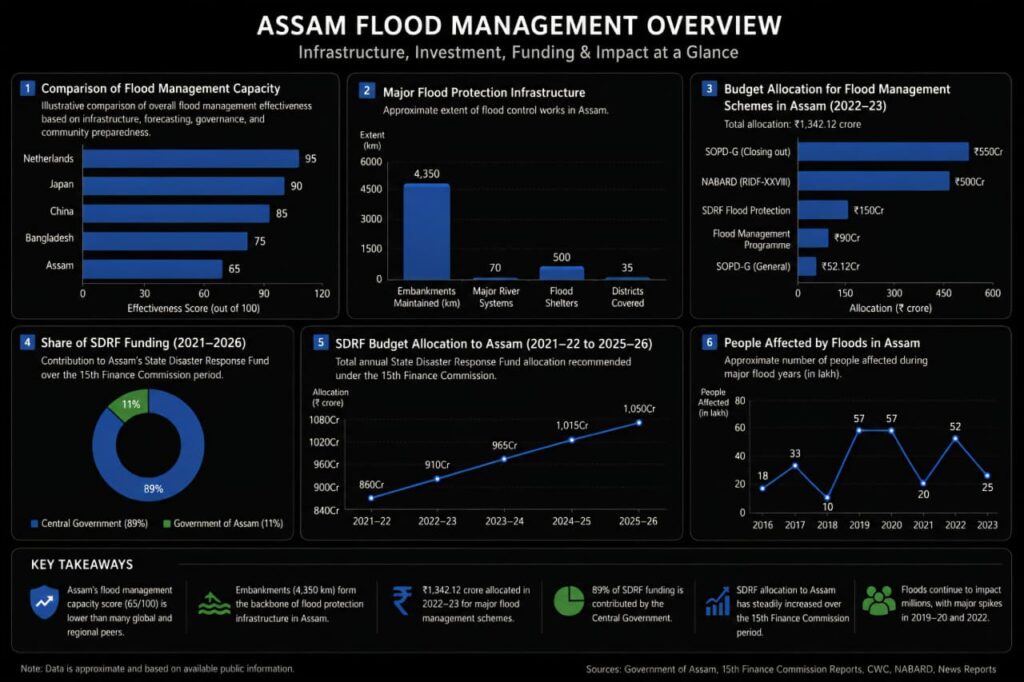
Major Government Reported Flood Impact:
Year
Impact
2016
Around 18 lakh people affected; widespread flooding in the Brahmaputra basin.
2017
More than 33 lakh people affected; Kaziranga National Park severely inundated.
2018
Moderate flood year affecting around 8 lakh people.
2019
Nearly 57 lakh people affected during peak flooding.
2020
Around 57 lakh people affected; among the worst floods in recent decades.
2021
Comparatively moderate flooding with localized damage.
2022
Over 54 lakh people affected; one of the most destructive flood seasons.
2023
Flood intensity lower than 2022 but several districts affected.
2024
Around 42.95 lakh people affected across 35 districts and 7,794 villages. More than 100 deaths were reported due to floods and landslides, making it one of the most severe flood seasons in recent years.
2025
Around 6.3 lakh people affected across 21 districts during the major flood wave. The season was less severe than 2024 but still caused significant displacement, crop loss, and infrastructure damage.
2026
As of late July 2026, over 7 lakh people have been affected across 11–12 districts, with 47–61 reported deaths. Rescue operations, relief camps, and central assistance remain ongoing, so the figures are provisional and may increase as the monsoon season continues.
Steps Taken by the Assam Government
The Government of Assam has implemented both structural and non-structural flood management measures.
A. Flood Control Infrastructure
The Water Resources Department undertakes Construction of embankments, Strengthening existing embankments, Anti-erosion works, River bank protection, Construction of sluice gates, Drainage improvement, River dredging, Channel improvement in selected rivers. The department reports maintaining over 4,400 km of embankments across Assam.
B. Assam State Disaster Management Authority (ASDMA)
Major initiatives include: 24×7 State Emergency Operation Centre, District Disaster Management Authorities (DDMAs), Daily flood bulletins, GIS-based flood monitoring, Community-based disaster preparedness, Flood shelters, Mock drills, Training of volunteers, Relief camp management, Early warning dissemination through SMS, and Coordination with district administrations.
C. Rescue and Relief
During floods the Government deploys: State Disaster Response Force (SDRF), National Disaster Response Force (NDRF), Police, Fire & Emergency Services, Medical teams, Veterinary teams, Boats, Helicopters (when required). Relief measures include: Temporary relief camps, Community kitchens, Food grains, Drinking water, Tarpaulins, Medicines, Clothing, Baby food, Cattle fodder and Sanitation facilities.
Budget Allocation for Flood Management in Assam
- State Disaster Response Fund (SDRF)
The Government of India and the Government of Assam jointly finance the State Disaster Response Fund (SDRF), which is the primary source for immediate flood relief and response.
For FY 2024–25:
Opening Balance: ₹527.69 crore
SDRF Releases (Central + State Share): ₹1,173.60 crore
NDRF Assistance Released: ₹29.02 crore
Total Funds Available: ₹1,730.31 crore
Expenditure (up to January 2025): ₹779.16 crore
Balance Available: ₹951.15 crore. (ASDMA) - Flood Management Schemes (2022–23)
During 2022–23, the Water Resources Department sanctioned several flood and erosion management projects:
Scheme
Allocation
NABARD (RIDF-XXVIII) – 38 schemes
₹499.98 crore
State Plan (SOPD-G) – 53 schemes
₹83.47 crore
SOPD-G (Closing of Breaches) – 22 schemes
₹519.28 crore
SDRF – 177 flood protection schemes
₹123.44 crore
Flood Management & Border Areas Programme (FMBAP)
₹115.95 crore
- Assam Integrated River Basin Management Programme (AIRBMP)
The Assam Integrated River Basin Management Programme is a long-term flood mitigation initiative supported by the World Bank.
World Bank Loan: US$500 million
Government Counterpart Funding: US$125 million
Total Programme Size: US$625 million. (Assam Government) - Capacity Building and Disaster Management Budget (2023–24)
The Assam Government also allocated funds for disaster preparedness:
Programme
Budget Estimate (2023–24)
Capacity Building for Disaster Response
₹94.60 crore
Assam State Disaster Management Authority (ASDMA)
₹14.44 crore
The obvious question, then, is this: despite the allocation of substantial budgets every year, why does Assam continue to suffer from the devastating consequences of floods year after year? Flooding in Assam is not a new phenomenon. It is an annual disaster that displaces millions of people, affects countless livelihoods, and claims numerous lives. While it would be unreasonable to hold any government responsible for the occurrence of natural calamities, it is entirely justified to question the policies, preparedness, and long-term strategies adopted to deal with them. What concrete and progressive measures has the Government of Assam taken to mitigate the recurring flood crisis? This is a question that demands an honest answer. When millions of people are affected by the same disaster every year, effective preventive measures and sustainable solutions become not only necessary but indispensable.
Every monsoon, social media is flooded with hashtags and messages such as “Pray for Assam.” While these expressions reflect empathy and solidarity, they should not replace more fundamental questions: Why does this continue to happen? Are we still not capable of preventing such large-scale devastation? Do we lack the necessary technology, expertise, or resources? Is it acceptable that natural calamities continue to dictate the limits of our development, forcing progress to surrender before predictable disasters? The images that emerged from this year’s floods shook the conscience of the nation. Heartbreaking scenes of human bodies and helpless animals being swept away by floodwaters raise disturbing questions. Can this tragedy not be prevented? How many more lives must be lost before meaningful action is taken? Why are we still not adequately prepared? At the same time, several videos showed helicopters dropping food and relief materials to flood-affected areas. At first glance, these efforts appear commendable. However, the reality on the ground often tells a different story. The critical question is not merely whether relief is being delivered, but whether it is reaching the people in a usable condition. In many instances, food packets and drinking water are dropped directly into floodwaters or muddy terrain. What are the victims expected to consume—water-soaked rice or food contaminated with mud? Providing relief is important, but ensuring that it reaches people safely and effectively is even more important. Such distressing scenes inevitably raise serious concerns about the efficiency and execution of disaster relief operations.
Ultimately, why must we repeatedly say, “Pray for Assam” every year? Why are prayers becoming an annual response instead of long-term solutions? It is equally important to examine the underlying causes that repeatedly compel us to rely on hope rather than preparedness.
If surrendering before natural calamities is the only option, then how have countries like Japan managed to coexist with some of the world’s most destructive natural disasters? If a nation like Japan has developed systems that significantly reduce the impact of tsunamis and earthquakes, why has Assam still not been able to protect itself from recurring floods? Similarly, countries such as the Netherlands, Singapore, South Korea, and Japan have built some of the world’s most advanced drainage and stormwater management systems. Why are we not learning from their experiences?
Despite possessing a larger economy than many of these nations, why have we failed to implement equally effective flood management systems where they are most needed? These are questions that must continue to be asked. If India is among the world’s fastest-growing economies, then why does a recurring and predictable flood crisis continue to expose such significant gaps in planning, infrastructure, and governance?
Region/Country
Similar Geographical Features
Major Disaster
Key Management Strategies
Lessons for Assam
Assam (India)
Brahmaputra River basin, Himalayan tributaries, heavy monsoon rainfall, extensive floodplains
Annual floods and riverbank erosion
Embankments, SDRF/NDRF response, flood forecasting, relief camps, erosion-control projects
Shift from reactive relief to integrated river basin management
Bangladesh
Ganges–Brahmaputra–Meghna delta, low-lying floodplains, monsoon climate
River floods, cyclones, erosion
Community flood shelters, raised houses, flood forecasting, cyclone preparedness, floating agriculture
Expand community-based resilience and climate-adaptive livelihoods
Netherlands
Delta of Rhine, Meuse, and Scheldt rivers; low-lying land
River and coastal flooding
Delta Works, “Room for the River” programme, smart dikes, advanced water governance
Create more floodplain storage instead of relying mainly on embankments
Japan
Mountainous rivers, typhoons, tsunamis, intense rainfall
Floods, landslides, tsunamis
Real-time early warning, hazard maps, evacuation drills, strict building codes, underground flood tunnels
Improve flood forecasting, public awareness, and evacuation planning
China (Yangtze Basin)
Large river basin with seasonal monsoon flooding
River floods
Sponge cities, reservoir regulation, flood diversion zones, ecological restoration
Adopt urban flood-resilience measures and restore wetlands
Indicator
Assam
Bangladesh
Netherlands
Japan
China
Early Warning System
Good
Very Good
Excellent
Excellent
Excellent
Community Preparedness
Moderate
Excellent
Excellent
Excellent
Very Good
Floodplain Management
Limited
Moderate
Excellent
Very Good
Good
Embankment Quality
Good
Good
Excellent
Excellent
Very Good
Smart Monitoring
Moderate
Good
Excellent
Excellent
Excellent
Nature-Based Solutions
Limited
Moderate
Excellent
Good
Very Good
Long-Term River Basin Planning
Moderate
Good
Excellent
Very Good
Excellent
Rank
Country
Why It Is Considered the Best
🥇 1. Netherlands
World’s leading water management system, Delta Works, “Room for the River,” advanced pumping stations, canals, smart drainage
⭐⭐⭐⭐⭐ Excellent
🥈 2. Japan
Massive underground flood diversion tunnels, urban drainage, real-time flood monitoring, disaster-resistant infrastructure
⭐⭐⭐⭐⭐ Excellent
🥉 3. Singapore
Smart urban drainage, Marina Barrage, ABC Waters Programme, rainwater harvesting, flood sensors
⭐⭐⭐⭐ Very Good
- South Korea
Smart drainage, underground storage tunnels, AI-based flood forecasting
⭐⭐⭐⭐ Good - Germany
Sustainable Urban Drainage Systems (SuDS), green infrastructure, floodplain restoration
⭐⭐⭐ Good - China
Sponge City Programme, permeable pavements, rain gardens, urban flood management
⭐⭐⭐⭐ Good
The monsoon in Assam also compels us to reflect on the state of urban drainage management. It raises an important question: why does Guwahati, proudly promoted as a Smart City with initiatives such as green buses and sustainable urban development, continue to struggle with severe waterlogging every time it rains? A city aspiring to be “smart” should not come to a standstill after a few hours of rainfall.
As soon as the monsoon arrives, large parts of Guwahati appear submerged. Waterlogged streets, flooded neighbourhoods, and inundated roads have become an all-too-familiar sight. These recurring scenes raise a fundamental question: why does the city face the same crisis every single year despite continuous claims of urban development?
Flyovers, though essential for improving connectivity and reducing travel time, are not a solution to poor drainage infrastructure. They may help vehicles move above congested roads, but they do nothing for the homes that remain submerged, the neighbourhoods trapped under water, or the streets rendered unusable by flooding. Flyovers can certainly be symbols of development, but they cannot replace efficient stormwater drainage systems.
Ironically, during the monsoon when the need for efficient urban mobility is greatest even these flyovers often witness traffic jams stretching for two to three hours as the roads below become waterlogged. Consequently, the monsoon exposes not only the devastating floods affecting rural Assam but also the chronic failures of urban drainage and traffic management within its largest city.
These are not merely seasonal inconveniences; they are recurring governance challenges. If Guwahati truly aspires to be a smart and sustainable city, then questions about its drainage infrastructure, urban planning, and traffic management must be asked with the same seriousness as questions about flood control across the state. Development should not be measured solely by the construction of flyovers or the introduction of green buses, but by the city’s ability to function safely and efficiently when faced with predictable seasonal challenges.
Scheme / Initiative
Implementing Agency
Funding Source
Project Data
Flood Management & Border Areas Programme (FMBAP)
Ministry of Jal Shakti + Government of Assam
Central Government
₹115.95 crore approved for erosion protection on the Aie River (Chirang District). (Assam Government)
Assam Integrated River Basin Management Programme (AIRBMP)
Government of Assam + World Bank
World Bank + State Government
US$625 million total (US$500 million World Bank loan + US$125 million State counterpart funding). (Assam Government)
NABARD (RIDF-XXVIII) Flood Protection Projects
Government of Assam
NABARD
38 schemes worth ₹499.98 crore. (Assam Government)
SOPD-G Flood Management Works
Government of Assam
State Government
53 schemes worth ₹83.47 crore. (Assam Government)
SOPD-G Closing of Breaches
Government of Assam
State Government
22 schemes worth ₹519.28 crore. (Assam Government)
SDRF Flood Protection Schemes
Government of Assam
SDRF
177 schemes worth ₹123.44 crore. (Assam Government)
Flood Forecasting & Early Warning
Central Water Commission + ASDMA
Central & State
Real-time flood forecasting, flood bulletins and warning systems across major river basins. (Water Resources Assam)
It would, however, be unfair to claim that the government has taken no steps to address this crisis. Successive governments have invested significant resources in flood relief, rescue operations, embankment construction, and rehabilitation. During every flood season, countless officials, disaster response personnel, healthcare workers, and volunteers work tirelessly to rescue stranded families and provide relief under extremely difficult circumstances. When faced with the overwhelming force of nature, no government can claim complete control over every disaster.
Yet, acknowledging these efforts should not prevent us from asking difficult but necessary questions. Appreciation and accountability are not mutually exclusive they must coexist in a healthy democracy. If floods continue to devastate Assam with the same intensity every year, then it is imperative to evaluate whether existing policies, infrastructure, and disaster management strategies are sufficient for the challenges of the present and the future. The true measure of governance is not merely how effectively relief is provided after a disaster, but how successfully suffering is prevented before disaster strikes. Flood management must evolve from a reactive approach to a proactive one—through scientific planning, modern drainage systems, river management, resilient infrastructure, environmental conservation, and the adoption of global best practices.
The people of Assam deserve more than annual assurances and seasonal sympathy. They deserve lasting solutions that allow them to live with dignity, security, and hope. Perhaps the day we no longer have to trend “Pray for Assam” on social media will be the day we can truly say that we have learned to coexist with nature rather than merely endure it.
Until then, the questions must continue to be asked not to assign blame, but to inspire better policies, stronger institutions, and a safer future for every citizen of Assam
